

My Documents
The document library — uploading, connecting a drive, finding a brief, and what the status and expiry labels mean.
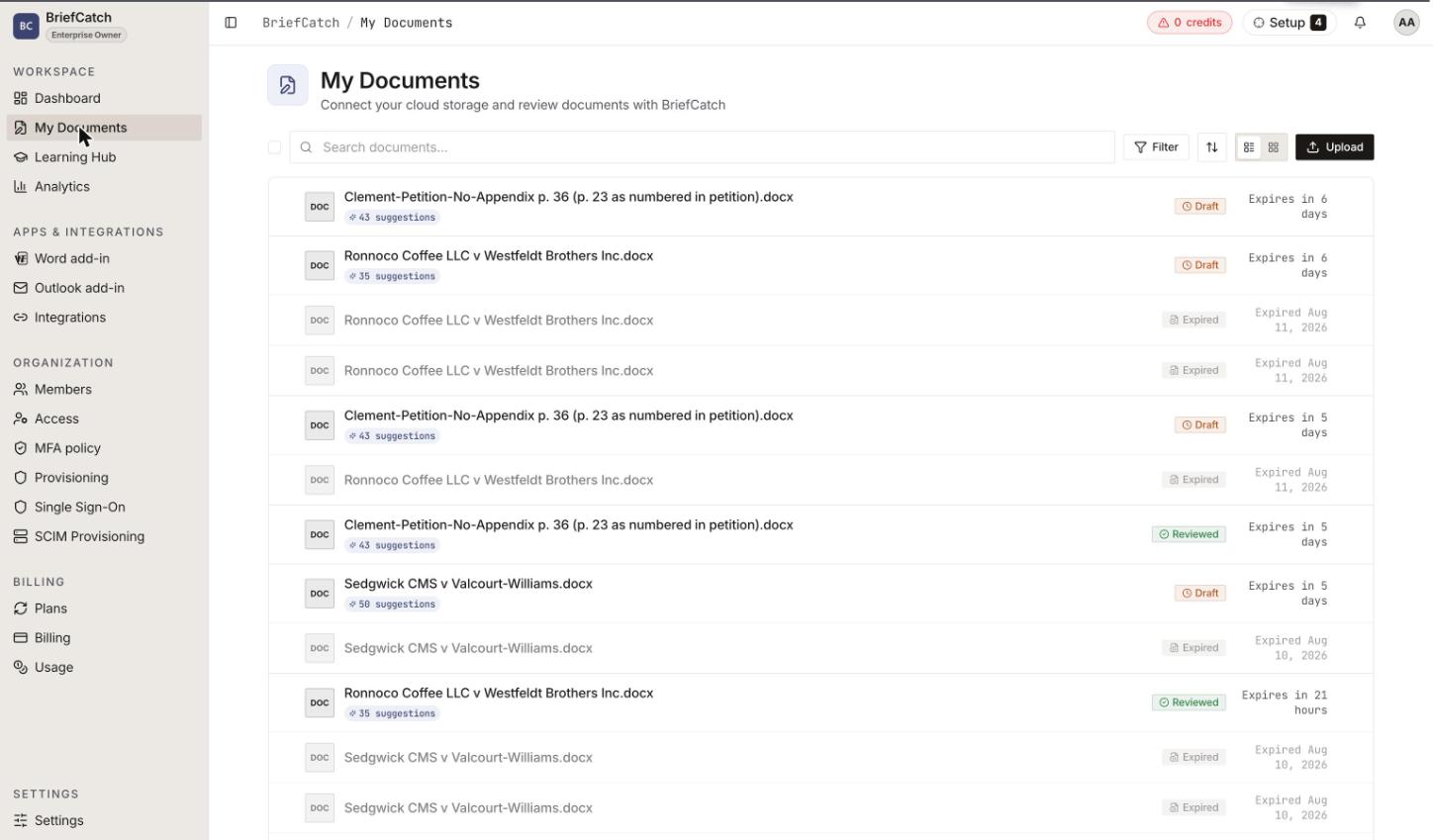
My Documents is the home of everything you have put through BriefCatch. It is both the place you start a review and the place you come back to for one you already ran.
What you see depends on your plan, your role, and which drives your organization has connected.
Getting a document in
There are two routes, and they behave differently afterwards.
| Route | Use it when | What to know |
|---|---|---|
| Upload document | The file is on your machine | Accepts .docx and .pdf, up to 25 MB. BriefCatch asks what should happen to the file afterwards. |
| Add from a connected drive | The file already lives in Google Drive or OneDrive | If no drive is connected, the library offers Connect a drive first. See Integrations. |
An older .doc file needs converting to .docx before it will upload.
The one choice worth reading: what happens to the file
Upload asks you to choose, because the answer decides whether the file still exists later.
- Keep a private copy for a while — BriefCatch stores the file so you can reopen the results without re-uploading. You pick an Auto-delete after window. Longer windows are a paid-plan capability; if the option is greyed out, your plan does not include it.
- Save to my Google Drive / OneDrive — a permanent copy in your own drive, managed by you.
- Save to the organization drive — a permanent copy in your organization’s drive, in a folder you choose.
Why this matters: only the drive destinations produce a copy you control. The private copy is on a timer, and when that timer runs out the file is deleted rather than archived.
Choosing a destination opens a folder browser scoped to what you can reach: Personal, Organization, My Drive, or a Shared Drive. You have to open a folder to select it — a file cannot be a destination.
Finding things
The toolbar carries search, filters, sort, and a List view / Grid view switch.
| Control | What it filters on |
|---|---|
| Search | File name |
| Scope | Personal or Organization |
| Provider | Which drive the file came from |
| File type | Docs versus other files |
| Status | Draft, Reviewed, Expired |
| Date, Name, Size | Sort order |
Active filters appear as removable chips, with Clear all to reset. Shared documents is a separate view for files other people in your organization shared with you.
If a connected drive has new files the library has not picked up, Sync drive documents refreshes it.
Reading a row
| Column | What it tells you |
|---|---|
| Status | Draft (uploaded, not reviewed), Reviewed (analysis finished), or Expired (the stored copy is gone) |
| Suggestion count | How many findings the review produced |
| Expiry | “Expires in N days”, counting down to the auto-delete window you chose at upload |
Selecting rows reveals bulk actions. Details opens a side panel with the document’s history, including previous review runs and, where available, author history.
Expiry, and what survives it
When a stored document expires, the file is deleted. A stub row can remain in the list with the name and timestamps, but the review itself does not survive: suggestions, verdicts, scores and version history are purged with the file. That is why an expired document cannot be opened — there is nothing left to open. Re-upload the source file to review it again.
When the library will not let you in
- “You cannot review documents with your current plan” — the account’s license does not include document review. See Plans and licenses.
- “Your trial has expired — upgrade to upload documents” — the trial ended. Existing documents stay readable and exportable; uploading and analyzing stop until the license is active again.
- “This document is still being processed” — analysis has not finished. Wait rather than re-uploading; a duplicate upload starts a second, independent run.
Related
- Review a document — what happens after upload
- Integrations — connecting Google Drive or OneDrive
- Plans and licenses — retention windows and review entitlement
- Troubleshooting — upload and processing problems